
Genoa, waiting in the queue for the ferry to Tunis, the trip takes about 24 hours

In Algeria at the Northern edge of the Sahara, heading for the Deep South

Everything is packed inside the car, only the sand ladders on a small roof rack. This worked very well

South of El Golea, heading for Ain Salah

The long road to Tamanrasset, my travel companions in their Toyota Land Cruiser in front of me

That's how a sand storm looks like, it is around noon

Once you have experienced a sandstorm, you understand that it erodes everything

Arrival at the desert town Ain Salah via the main road from El Golea to Tamanrasset

Around Arak, a Tuareg, probably an Ikelan, once a caste of slaves within Tuareg society ...

... and his Camel, Camels always have a look in their eyes as if they have some contempt for man

A religious gathering at Arak

A Marabout, a religious leader and teacher

South of Tamanrasset, we supplied this Tuareg with some water, watch the height of his camel

And more camels, watch the eyelash of this beauty

This is the way you climb a camel, it requires a special technique

The majestic sight of two Tuareg riding their camels

Passengers shelter from the sun in the shade of the truck, while the driver is fixing it

Truck drivers in the Sahara are usually excellent mechanics, here the clutch is being fixed

Horse power meets camel power, virtually in the middle of nowhere, close to the border with Niger

After exchanging pleasantries, the riders are getting on their camels to continue their journey

In the warm light of the late afternoon, they are leaving us in Northern direction, maybe to Tamanrasset

The beautiful sight of another caravan, it was 1986 and we were wondering for how long this would go on

In this desolated area we found beautiful rock art

The Neolithic people just painted, actually carved, what they saw

Art of the Neolithic Rembrandt, still beautiful after 7 millennia

Standing on this ridge, in one direction we had a view on our cars ...

... in the other direction on this magnificent piece of rock art ...

... this piece of rock art is probably the biggest in the Aïr mountains

The rear of the car, fully covered by "Fech Fech”, a very fine powder caused by the erosion of clay-limestone terrain

Témèt, a breathtaking area, seen in Southern direction, on the left the travelling sand dunes, on the right the Aïr mountains

Témèt, standing on "the bottom" of the see of sand, on the left, one of the immense travelling sand dunes

Témèt, in the middle an old volcano can be seen, the hard lava inner core is still standing, it does not erode easily

From Témèt on our way North, to Adrar Bous

Heading for Adrar Bous, these are the moments that you realize how important it is to drive a well equipped car

Adrar Bous

Adrar Bous, the planes in front of us were littered with Neolithic artefacts

Adrar Bous, the cars are actually standing on the bottom of a dry lake, fish bones could still be found

A last view of Adrar Bous, before heading South to Adrar Madet

On our way from Adrar Bous to Adrar Madet

The sun sets as we are preparing our camp for the night

Our guide Idris calls it a day and enjoys the late afternoon

The next morning, Idris is considering the best route to be taken, in the mean time the wind is ramping up

Adrar Madet

On the piste between Adrar Madet and the Gorges d’Agamgam

Gorges d’Agamgam

On our way from the Gorges d’Agamgam to "La pince du crab" d'Arakao, meaning the claw of the lobster of Arakao

Sand dunes between the Gorges d’Agamgam and "La pince du crab" d'Arakao

View on the Aïr between the Gorges d’Agamgam and "La pince du crab" d'Arakao

Our night camp, with view on the Aïr between the Gorges d’Agamgam and "La pince du crab" d'Arakao

Our loyal Mecedes G is waiting while we climb one of the sand dunes

The view from one of the sand dunes near "La pince du crab" d'Arakao
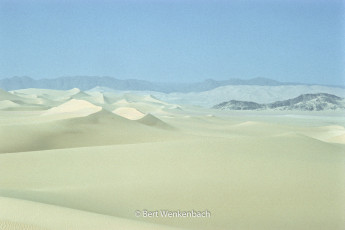
"La pince du crab" d'Arakao, it is a rock formation grouped in a half-circle, the half-circle is "filled up" with sand dunes

East of the Aïr mountains the Ténéré begins, the Tuareg call it the desert of deserts, the slide makes you understand why

Crossing the sand dunes situated within "La pince du crab" d'Arakao

On our way to The Blue Mountains, we cross a "fata morgana"

A stop on a dune, close to the Blue Mountains

Approaching Adrar Chiriet

A row of majestic sand dunes in front of Adrar Chiriet

A sand dune in front of Adrar Chiriet, one can see how the wind, blowing from right to left, has shaped the dune

A star dune, shaped by varying wind directions, close to Adrar Chiriet

A barrier of sand dunes in front of Adrar Chiriet

Some areas around Adrar Chiriet are very difficult to penetrate

Another look at Adrar Chiriet, geologically it looks like a "round cake of mountains", put on the sand bottom

Here we made our night camp, with view on Adrar Chiriet

Another view on Adrar Chiriet, in the haze of the late afternoon

Little waves in the "Sea of Sand", with a wavelength of about 10 centimetres

Around Adrar Chiriet in the crisp morning light

And a last farewell to the majestic Adrar Chiriet and to the Aïr Mountains

Back in Iferouane the first inhabited village after 8 days, we meet some Tuareg

South-West of Tahouat, granaries in a small settlement, the baobabs are trees so charactereristic for Africa

Woman, probably belonging to the Bororos "Peuls" tribe, preparing food

On the Tanezrouft piste between Gao and Tessalit, a signpost is indicating the road to Timbuktu

Our night camp on the Tanezrouft, the daily preparation of the cars before leaving for a long day driving

Tanezrouft is a vast and barren plain extending from Timbuktu more than 1500 KM to the North

Timimoun, the palm grove of Igsher, in the middle a marabout grave, at the horizon the chott, a dry salt lake

Timimoun, the vast palm grove of Igsher, the chott (a dry salt lake) and the sand dunes North of the village

On the road to El Golea (now El Menia), the picture is taken South of the town

The town of Gardahïa, Algeria, founded by the Mozabites, a Muslim Ibadi sect of non-Arabic Muslims, including the Berbers

The Roman Zaghouan aqueduct South of Mohammedia, once used to supply Carthage with water

Waiting for the ferry to Genoa, together with some participants of the Paris-Dakar rally