
Our Land Rover, fully packed and equipped, ready for departure

The next day, around Belfast (eastern Transvaal), refuelling the car and additional jerry cans

Sabi River, in the southern part of the famous Paul Kruger Wild Life Reserve

Our first encounter with African wildlife, a springbok in beautiful camouflage colours

And a springbok couple or an impala couple as the English say

Face to face with a giraffe, who has just like human beings seven cervical vertebras

And our first elephant; we got the impression that the wildlife in the Kruger Park, contrary to Botswana, was very used to humans

Our night camp close to Tzaneen (Limpopo province, South Africa)

A small settlement in the early morning fog (Limpopo province, South Africa)

The border post Musina-Beitbridge between South Africa and Rhodesia

The Limpopo River seen in easterly direction

Flat bush land, the landscape between Beitbridge and Fort Victoria (Masvingo), in the late afternoon

The conical tower inside the "Great Enclosure" at Great Zimbabwe

Beautiful masonry, the stones are stacked without the use of mortar

The Great Enclosure at Great Zimbabwe, seen from the outside

Our night camp near the road between Fort Victoria (Masvingo) and Birchenough Bridge, the Land Rover besides a huge Baobab tree in the early morning light

A small village between Fort Victoria (Masvingo) and Birchenough Bridge

A characteristic Rhodesian road, just "one car width", cars passed each other by steering the car half on the tarred strip and half in the gravel part of the road

Birchenough Bridge over the Save River, it is the "sister" of the Sydney Harbour Bridge and constructed by civil engineer Ralph Freeman

A half shaft broke, an infamous Land Rover problem, a part of the shaft is still in the differential

Our Land Rover broke down almost in the middle of the road, but because there was no traffic, we could work on the car for hours without any problem

A small settlement between Birchenough Bridge and Umtali (Mature)

Wide planes between Birchenough Bridge and Umtali (Mature)

A kopje (granite rock) around Umtali (Mature)

At a lay-by close to Salisbury, Remo is baking his famous pancakes, Hans is tasting them and Bert is writing home

Nice view over the centre of Salisbury from the Kopje

The road from Salisbury to Mozambique, here we joined a Rhodesian Army convoy to drive under their protection to the border with Mozambique

A camp of the Rhodesian Army, close to the border with Mozambique, this was "operational area" (bush war zone), clearly visible is the machine-gun nest to welcome unsolicited guests

The last miles to the border with Mozambique, landmines were a serious danger

Border control by a 15 year old kid, but the customs were friendly, they knew about the lavish development aid, spent by the left Dutch government

Inspection, inspection and more inspection by the Mozambican customs, it took at least half a day

As soon as we entered Mozambique, we saw this kind of posters everywhere, it was clear that FRELIMO tried to get firm grip on the country, but that resulted in 1977 in a civil war

The brand new bridge over the Zambezi in the town of Tete, completed in 1973 by the Portuguese, was used as a supply route for the construction of the Cabora Basa Dam

Our lonely Land Rover on the bridge, the town of Tete was effectively deserted in the autumn of 1975, today the traffic has increased in such an extend that a second bridge had to be built

Our Land Rover somewhere on the road in Malawi

The Zomba Plateau, Malawi, with some small settlements, parts of the plateau reach an altitude of 1800 meters

The Zomba Plateau in the late afternoon, we are heading in Northern direction for the Lake Malawi

For the local kids, we were a big attraction when we set up our camp at the shores of Lake Malawi (Lake Nyasa)

One of the tranquil local settlements on the South-Western shores of Lake Malawi

The border post between Malawi and Zambia, half way between Mchinji and Chipata, crossing borders in Africa meant always endless paper work

The bridge over the Luangwa, here soldiers confiscated my film because I took a picture from it, but they were so stoned that they were not aware of a second photographer

The bridge over the Luangwa with the remains of the first one, which was destroyed in 1964 during the Rhodesian bush war

Be aware of elephants crossing the road!

The road between Livingstone and Kazungula

The Victoria Waterfalls; here the Zambezi River plummets in a single vertical drop into a transverse chasm 1708 meters wide, the drop is over 100 meters

The Victoria Waterfalls are considered to be one of the seven Natural Wonders
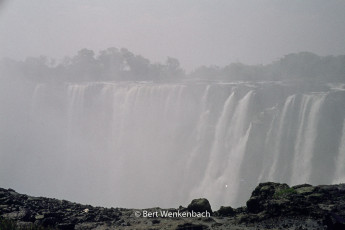
By the indigenous people, the Victoria Waterfalls are called Mosi-oa-Tunya: The Smoke That Thunders

The famous bridge over the Zambezi, between Zambia and Rhodesia, officially closed but in practice heavy in use for cross border traffic

Garrett steam engines were non-stop hauling freight from all parts of Rhodesia to supply countries like Zambia with food

These robust steam engines were still in service around 2006 because, with Zimbabwe's self-ruled economy, one could not afford to buy new ones

The nice camp site at Victoria Falls; we took a break to check and prepare the Land Rover for the trip trough the bush of Botswana

The entrance of Chobe National Park in Botswana; here, we needed to have all our jerry cans to be filled up
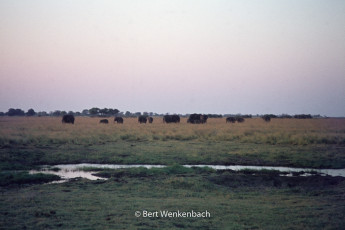
A herd of elephants returns from a bath in the Chobe River

A herd impalas in the crisp morning light, close to the Chobe River

The "high way" to the Savuti Channel camp site; these roots could be very tricky for the tyres because they are acting like nails

This is called a "road block"

Sometimes, elephants pull down trees like this one, so it's much easier for them to get the tender leaves in the tree tops

On tracks like this one, you need everything a Land Rover can offer you when it comes to off-road capability

Crossing the Savuti Channel to reach our night camp on the other side of the river

This was a solitaire elephant bull that has lived in this area for decades, at least until the 1990's

The bull was huge; you can compare his size with the car tracks

The proverbial elephant in a china shop

This elephant came quite close, but if you don't make him upset, you can avoid trouble

Water is something elephants simply love, for a bath or just for a cool drink

And on the road again, the African savannah is not only impressive to see, sometimes you can almost smell the game

The guarantee on this elephant has expired, vultures have cleaned the carcass until all meat has been eaten away

Galloping Zebras; we drove here at least 60 KM to keep them in the viewfinder of the camera
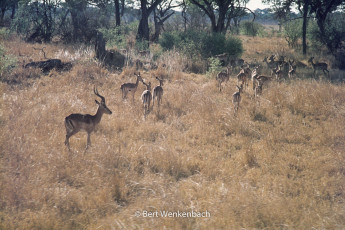
A herd of gazelles; the goat at the left is keeping an eye on us, in the mean time the herd disappears in the bush

Elephants have their fixed routes; here, they were walking straight towards our Land Rover, which was obviously standing on the point where their route crossed the road

A few minutes after we drove our car backwards, the majestic animals crossed the road, exactly at the place we were standing

We could come very close to this beautiful lion lady, one of a group of a few with cubs

Although she was on high alert, she stayed relaxed as well

This is aunty with the two cubs

Beautiful and amazing to see how well camouflaged these animals are

And that is especially true for the cubs; camouflage belongs to their first line of self-defence

Our Land Rover at the entrance of the Moremi Wild Life Reserve at Maqwee

One of the characteristic wooden bridges in the swamp of the Moremi Wild Life Reserve

Here another passage through the water; you have to check in advance by foot, weather there are no spots that are too deep for the car
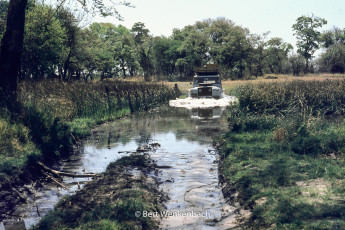
Moremi is so swampy, because the Okavango River simply evaporates here, that means sometimes more water than road

Here, the Okavango River becomes open water and is navigable by boots or canoes

Moremi is also well known for their colonies of birds, here we see a colony of Yellow Billed Storks

The Okavango Delta, north of Maun

After a week of touring through the Chobe and Moremi Wild Life Reserves, we arrived in the town of Maun, located at the northern edge of the Kalahari Desert

Maun is a melting pot of ethnic groups, among them the Herero, who are living from their livestock

More Herero women, the clothing is inspired by the fashion of the German settlers in Namibia, but they combined it with their own fabric and colours

The road, leaving Maun in easterly direction, with a lot of cows "en route"

The Makgadikgadi Salt Pans, the remains of the Lake Makgadikgadi, once a huge lake the size of Switzerland

Our Land Rover on the salt flats, the largest in the world

On the dust road between the Makgadikgadi Salt Pans and Francistown
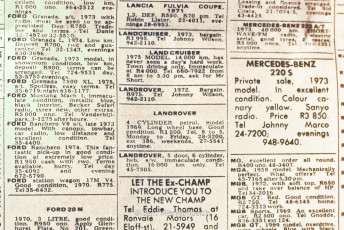
Back in Johannesburg, the end of our trip and our faithful Land Rover for sale again