
The first thing you see when arriving in Sri Lanka, is the airport; the warm humid atmosphere feels like a blanket …

… Sri Lanka, meaning the venerable island, also has a venerable animal in its flag as a symbol of strength, the lion …

… the symbol of a lion in Sri Lankan heraldry was introduced in 486 BC by Vijaya, the first King of Sri Lanka, who arrived from India.

In Sri Lanka, Buddhism is omnipresent and deeply rooted, dating back 2500 years …

... to the old capital Anuradhapura and the now restored Abhayagiri stupa, that was part of a major monastery site …

… guarded by sensual women …

… sensible elephants …

… and cheeky monkeys …

… or the Ruwanweliseya stupa, dating back to 160 B.C., that is still in use today …

… where the Buddha is still worshipped by the local people …

… and by monks alike.

Around 1070, Polonnaruwa became the capital and the Buddhist centre, the sacred tooth of the Buddha was kept in the Atadage Dalada Maligawa …

… another magnificent structure is the Polonnaruwa Vatadage, it is believed to have been built during the reign of king Parakramabahu …

… after almost thousand years, the architecture and sculpting art is still magical …

… ancient Sinhalese rock carving and sculpting arts at its best can be seen at the Gal Vihara, the rock monastery, like this seated image …

… or this reclining image, which depicts the Buddha's parinirvana, the moment the Buddha attains nirvana.

Not everything went peaceful in Sri Lanka, King Kashyapa built the Sigiriya rock palace to protect himself from his brother King Mogallana …

… after he took the throne by force, at least he had a magnificent view, where he could reflect on his actions …

… and he had a harem, so he had not to live in solitude, the ladies were beautifully depicted in frescos dating from the 5th century …

… however, Moggallana was able to defeat Kashyapa, and the rock fortress was destroyed; what happened to the ladies is unknown 😉

Not far from Sigiriya, the Dambulla rock temples can be found, dating back to the Anuradhapura and Polonnaruwa period …

… the second of the five caves is called the Cave of the Great Kings and is the most impressive one …

…. It contains16 standing and 40 seated statues of the Buddha …

… and numerous mural paintings, inspired by the life of the Buddha …

… in the third cave, decorated in the typical Kandy style, in addition to the 50 Buddha statues, there is a statue of Kandyan king Kirti Sri Rajasinha …

… in this third cave, called the Maha Alut Viharaya, there is also a beautiful statue of the reclining Buddha.

But Sri Lanka is much more than its past, it is the county of the many faces, like Mr. Jabbar, the greengrocer in Kandy …

… of friendly people …

… old and young, …

… of this beautiful Hindu woman, …

… the fire chief …

… and the gardener, …

… where young women can study if they want, …

… participate at all levels …

… of society …

… and chat with everybody they like, during long train rides.
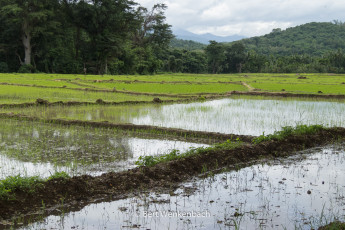
It is the land of the paddy fields …

… where small dams provide practical transport solutions …

… like the railways, which are used in the same way.

It is the land of the abundant nature …

... where elephants still roam freely in the wetlands …

… and in the game reserves …

... where food literally grows on trees ...

… you just need to harvest it.

If you take the train from Kandy to Nuwara Eliya, you will drive right through the tea plantations …

… these tea plantations, originally created by the British, define the landscape around Nuwara Eliya …

… the tea bushes are planted close together on the hills and picking the small delicate tea leaves is a labour-intensive process …

… in the heart of the tea plantations, you will also find the tea factories …

… like the Dambatenne tea factory, close to Haputale …
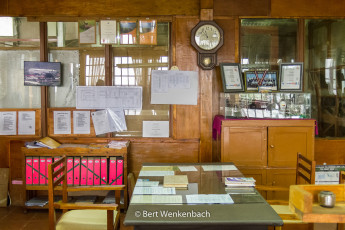
… where it seems as if time has stood still.

With the tea plantations came the need for transportation and that is how a vast railway system came into existence ...

… is still feels very British with the cast iron structures …

… the well-known hierarchical structure …

… the indispensable time tables …

… some of the old rolling material …

... today the Sri Lankan railways are still a very important means of communication …

… if trains arrive, stations become temporarily as busy as a bee hive …

… but soon thereafter they become a quiet place again where you can contemplate on whatever you like.

Sri Lanka is also home to a large Hindu community, who have their own culture, symbolized by the distinctive Hindu temples …

… meticulously detailed, like the Sri Muthumariamman Temple in Matale …

… Hindus have a complex pantheon of deities, one of the most prominent being ape-god Hanuman …

… their culture is also reflected in the many festivities, one of the most important being Hindu marriage …

… the wedding is also an important celebration for the Singhales people, bride and groom are dressed in beautiful clothes inspired by the Kandyan royals …

… if families can afford it, the wedding ceremony is held in luxury, like here, where a part of the Hotel Suisse is rented for the festivities.

The Hotel Suisse is located at the Kandy Lake, where also the venerable Queens Hotel can be found …

… the Kandy lake and the Queens Hotel “are” more or less the centre of the town …

… where the streets are busy …

… the monks are “well connected” …

… and almost everything can be found, like an attorney if you need one …

… or a delicious stuffed pancake if you are hungry …

… or offerings such as lotus flowers can be bought …

… in case you want to visit one of the many small devales (temples) …

… or the temple of the sacred tooth …

… and where the buses run until late in the evening to many destinations.

And when you have enough of the busy city, find a Tuk Tuk and explore Kandy’s environment …

… buy some food from a roadside shop and off you go, it offers you the ultimate freedom …

… go to places like the Hindagala Viharaya, the present temple is dating from the 17th century …

… and is decorated with beautiful mural paintings …

… or have a look at one of the smaller and almost hidden Viharayas around the town …

… enjoy the majestic Botanical garden …

… or relax in the late afternoon at one of the hilltops around the town.

A nice and relatively unknown trip from Kandy is to take the bus to Mahiyangana …

… where you will find the Mahiyangana Raja Maha Vihara, it is believed to be the site of the Buddha's first visit to the country …

… and is therefore a place of pilgrimage for many Buddhists …

… the present stupa has a height of 37 meter, it originally dates back to a small stupa, erected after the Buddha’s visit …

… and probably one of the most worshipped places in Sri Lanka …

… little flags with prayers are hung from trees …

… small offerings in the form of flowers or fruit are bought and taken inside …

… and of course there is the ritual of lighting incense sticks …

… and that brings us to our own “ritual of the last day”, the Negombo bus which brings us to the airport for our inevitable return trip.